Elmiron Vision Loss Lawsuit and Expected Settlement Amounts
October 25, 2026 by Mohr Marketing
Elmiron has been associated with pigmentary maculopathy, a retinal condition that can damage vision. Elmiron vision loss lawsuit marketing should make that distinction clear.
It’s reasonable to want straight answers about what long-term use may mean for your eyesight and whether a lawsuit could apply to your situation. Research has associated prolonged Elmiron use with retinal changes, and the drug’s label was updated in 2020 to warn about changes in the retina, including pigmentary maculopathy.
This article explains the reported link between Elmiron and pigmentary maculopathy, factors that may affect a claim’s value, and what is known about reported risks and FDA warnings. It also explains why estimated settlement ranges do not guarantee payment and which details may matter when assessing an Elmiron vision-loss case.
Key Takeaways
- Understand how Elmiron use has been associated with pigmentary maculopathy and which vision changes researchers have reported.
- Separate public settlement estimates from disclosed settlement terms, and learn what case details can affect a claim’s value.
- See what the FDA label warning says about retinal changes and what is known about Elmiron’s recall status.
- Review reported long-term risks, including evidence that vision damage can continue after a person stops taking Elmiron.
- Learn how Elmiron, also known as pentosan polysulfate sodium, is used to treat interstitial cystitis.
Elmiron and pigmentary maculopathy
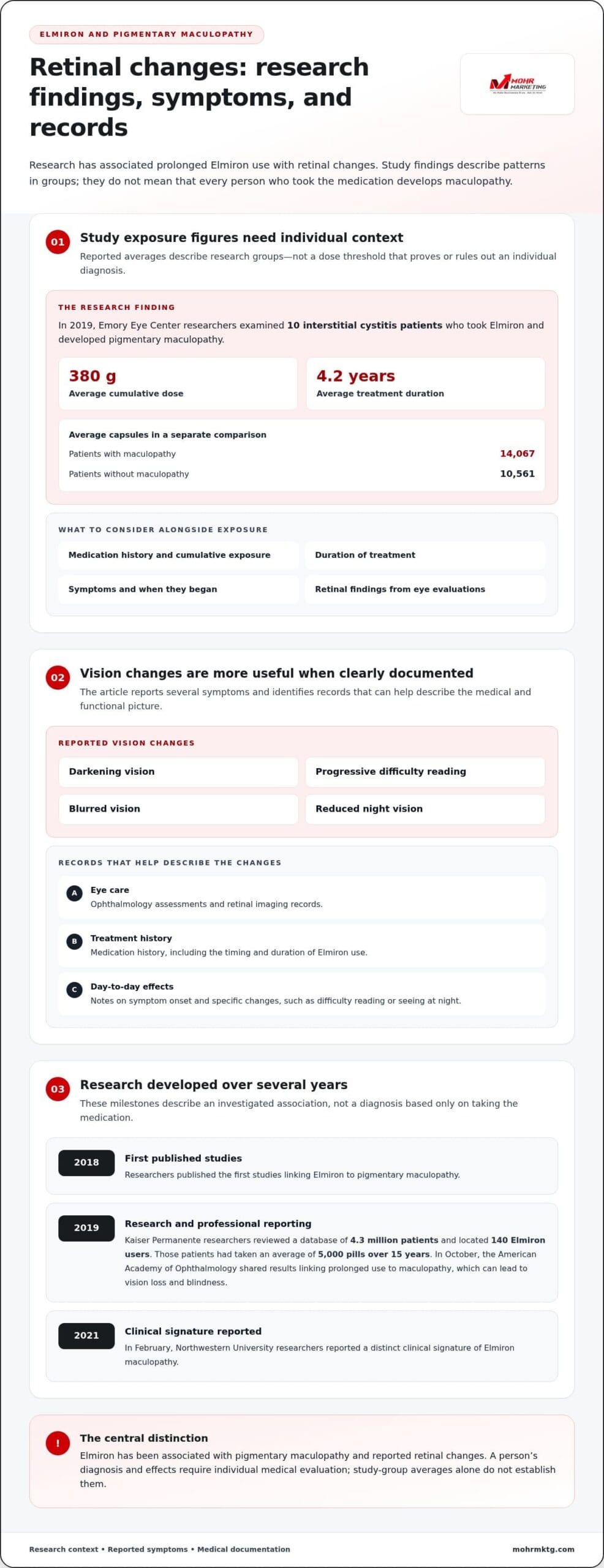
Elmiron, also called pentosan polysulfate sodium, has been associated with pigmentary maculopathy, a condition involving changes to the retina. Researchers published the first studies linking Elmiron to this condition in 2018. The reported concern is eye damage that may affect vision, including progressive changes that can continue after treatment ends. These findings do not mean every person taking the bladder medication develops maculopathy. They identify a potential risk associated with exposure that patients and clinicians can assess through medical records and eye evaluations.
In 2019, Emory Eye Center researchers examined ten interstitial cystitis patients who took Elmiron and developed pigmentary maculopathy. Their average cumulative dose was 380 grams, and average treatment duration was 4.2 years. Another comparison found that patients with maculopathy had taken an average of 14,067 capsules, while patients without it had taken 10,561. Those figures describe study groups, not a threshold that proves or rules out an individual diagnosis. Duration, cumulative medication exposure, symptoms, and retinal findings all provide relevant context.
A separate investigation shows how researchers examined the possible connection. Kaiser Permanente researchers reviewed a database of 4.3 million patients and located 140 Elmiron users. Those patients had taken an average of 5,000 pills over 15 years. In October 2019, the American Academy of Ophthalmology shared results linking prolonged Elmiron use to maculopathy, which can lead to vision loss and blindness. In February 2021, Northwestern University researchers reported a distinct clinical signature of Elmiron maculopathy. Together, these findings describe a pattern under investigation, rather than a diagnosis based only on taking the medication.
Medical confirmation matters because vision complaints can take different forms. Reported symptoms include darkening vision, progressive difficulty reading, blurred vision, and reduced night vision. A case report described a 41-year-old woman diagnosed with Elmiron-related PPS maculopathy after developing darkened vision, trouble reading, and night-vision loss. To document a suspected injury, retain ophthalmology assessments, retinal imaging records, medication history, and notes describing when symptoms began. These records help show the relationship between treatment, observed retinal changes, and functional effects.
Pigmentary maculopathy is the central retinal condition discussed in Elmiron-related claims, but reports also describe broader vision injuries. The 2019 Emory study compared affected Elmiron patients with people treated for the same bladder condition who did not use the drug. That comparison helps explain why clinicians and legal reviewers consider both diagnosis and exposure history. A medical record should identify the retinal findings and describe their impact, such as difficulty reading or seeing at night. The combination clarifies the alleged injury beyond a general report of eye discomfort.
What Are Expected Elmiron Settlement Amounts?
If you took Elmiron and have vision problems, seek an eye examination and preserve your medication, diagnosis, and treatment records.
Settlement and Jury Payouts
Settlement estimates are not the same as jury payouts. A jury award follows a trial and depends on the evidence presented. When reviewing a reported amount, ask whether it refers to one claimant, a group resolution, or a projected total across litigation. These figures describe different things.
Confidential Settlements and Potential Amounts
Janssen Pharmaceuticals and Johnson & Johnson began quietly settling some Elmiron lawsuits in 2023, without publicly disclosing official settlement amounts. That confidentiality limits what public estimates can show about individual compensation. That figure describes an aggregate estimate, not an individual award. Distinguish projected totals from disclosed payments when assessing claims involving pentosan polysulfate sodium.
Potential Compensation Categories
Potential compensation may cover financial losses and personal harms connected to retinal injury. Financial losses can include documented medical expenses, income lost when vision problems affect work, and ongoing care costs. Personal harms may include pain, reduced independence, or difficulty with everyday tasks. Organize records by category: invoices and treatment statements for expenses, employment documents for income effects, and specific examples of changes to daily routines.
Damages in Vision-Loss Claims
Vision-loss damages depend on how the injury affected a person’s life and what records support that impact. A retinal diagnosis alone does not capture the full consequences. Documentation can establish the timeline of symptoms, treatment, and functional limitations, such as difficulty reading or navigating familiar places. The severity and persistence of impairment, medical expenses, and effects on work or daily activities may help explain claimed losses. Keep dated records and describe concrete changes.
For law firms handling Elmiron inquiries, organized intake can capture medication history, diagnoses, and reported vision effects consistently. Discuss legal intake support when your team needs a structured way to collect those case details.
A law firm reported that no Elmiron settlements had occurred when its page was written. That statement is distinct from estimates of potential compensation.
FDA label warning and recall status
Elmiron’s safety-label history changed in June 2020, when information about retinal disease was added. Janssen updated the label in 2020 to warn about changes in the retina, including pigmentary maculopathy. That warning matters for patients reviewing medication history, and for attorneys assessing what product information accompanied treatment. It does not, by itself, establish why a particular person developed eye damage or determine the outcome of a claim.
The updated label states that most reported cases of retinal pigment changes occurred after 3 years of use or longer. This duration describes reported cases, not a guaranteed point when injury begins. A patient’s treatment timeline should therefore be reviewed alongside eye examinations, symptom history, and the label version relevant to their prescription period. A dated prescription record, for example, can help clarify whether use continued before or after the warning was added.
The label also lists optic neuritis, amblyopia, and retinal hemorrhage in the less than 1% category. These are distinct conditions, not alternative names for pigmentary maculopathy. A diagnosis should be read as written in the ophthalmology record, then compared with the label’s specific terms. Lawyers reviewing an Elmiron claim may consider this distinction when organizing medical evidence. A broad note saying “vision problems” does not identify which retinal or eye condition was diagnosed.
Recall status is separate from label warnings. The U.S. Food and Drug Administration has not asked Janssen to recall Elmiron, and Janssen has not said it plans to issue a recall. A label update communicates a safety warning; it does not remove a medication from the market. Recall status does not prove Elmiron is risk-free, nor does it mean every user will have the same outcome.
To build a clear record, gather prescription history, available package or pharmacy information, dated eye-care notes, and a symptom timeline. Note specific changes, such as blurred reading or difficulty seeing at night, and when they began. Discuss this information with the treating clinician to address eye health and medication decisions. Do not stop or change prescribed treatment solely because of a lawsuit or label summary.
Studies and label language can inform questions about serious risks, including vision loss and blindness, but they serve different purposes. Research reports observed patterns; the FDA label summarizes warnings and reported effects. Neither alone proves the cause of an individual injury. An attorney assessing a claim may compare these records with the diagnosis, exposure history, and documented vision changes. Keeping the documents together makes the sequence easier to review.
Reported risks associated with long-term Elmiron use
Medical research has linked longer Elmiron exposure with greater concern about retinal damage, including pigmentary maculopathy. Findings vary across studies, so exposure history and documented eye changes both matter when assessing risk.
Vision Problems Associated with Elmiron
A 2019 study examined 91 Elmiron patients who had taken the medication for more than 15 years. Researchers found clear indications of retinal damage associated with macular degeneration in 22 patients. A UCLA study also found evidence of retinal damage in 20% of long-term users. These findings describe study groups, not an individual’s personal likelihood of injury. They do show why long-term use and eye findings are considered together.
Duration may be relevant. Emory researchers found significantly increased odds of maculopathy after 7 years of Elmiron use compared with 5 years. Another review reported that affected interstitial cystitis patients had used Elmiron for 3 to 22 years, with a median duration of 16-17 years. Those study observations do not establish a precise exposure threshold. They help explain why a treatment timeline is important when reviewing possible side effects.
Vision Symptoms
Reported symptoms include blurred or darkened vision, progressive difficulty reading, and reduced night vision. Timing varies: symptoms have been reported to typically start within one year of taking Elmiron, while research also describes delayed or worsening problems. Record the first noticed change, its progression, and its effects on daily tasks. For example, note when reading becomes difficult or night driving becomes less manageable.
Symptoms can persist after treatment stops. Emory School of Medicine researchers reported that vision continued worsening for some people diagnosed with Elmiron maculopathy, even 10 years after discontinuing the medication. One reported example involved a 62-year-old woman who had used Elmiron for 18 years and experienced increasing vision damage for six years after stopping. This illustrates why stopping exposure does not necessarily end the need to track symptoms.
Research has also examined cumulative exposure. One report found drug toxicity in 11% of patients taking 500-1000 grams of Elmiron, compared with 42% of patients taking 1500 grams or more. These findings concern the studied groups and should not be treated as a personal prediction. For a useful medical timeline, gather prescription records, note treatment duration, and preserve dated eye assessments and symptom descriptions. Those details help distinguish a general vision complaint from documented retinal injury.
Elmiron and pentosan polysulfate sodium
Elmiron is the brand name for pentosan polysulfate sodium, a medication used to treat interstitial cystitis. The FDA approved Elmiron for this condition in 1996. Knowing both names helps patients connect prescription records, pharmacy histories, and medical notes that may use different terms. Search those records for “Elmiron,” “pentosan polysulfate sodium,” or “PPS” when building a treatment timeline.
Interstitial cystitis is the condition Elmiron was approved to treat, not an eye disease. The medication’s bladder-related purpose and its reported retinal risks are separate parts of its safety profile. This distinction matters when reviewing medical history: treatment records may explain why medication began, while eye-care records document later vision problems. Keep both together to show the sequence of treatment and reported effects.
Elmiron’s treatment timeline can extend over months. Its label states that patients may need to take the medication for at least six months before seeing benefits. The reported treatment guidance also says a doctor should reassess a patient after 3 months and may extend therapy by another 3 to 6 months. These milestones help explain continued use, but they do not establish that every patient responds or experiences the same effects.
Write down prescription start and stop dates, dose information shown in records, and why treatment continued. Add dates for any interstitial cystitis reassessment and eye examination. This timeline can help distinguish the treatment period from when vision symptoms appeared. Pharmacy histories, medication lists, and dated clinical notes can each contribute useful details.
The key issue in an Elmiron-related vision claim is the documented connection between medication use and eye injury. The brand name alone does not show whether someone developed pigmentary maculopathy or another retinal condition. Medical records should identify the diagnosis and describe observed changes. Treatment records can then show how long pentosan polysulfate sodium was used and whether symptoms arose during or after that period.
Reported vision damage may persist after a patient stops taking Elmiron, so the end of treatment is not necessarily the end of the medical timeline. Keep later eye assessments with earlier prescription records. When discussing the history with a clinician, separate bladder symptoms, medication exposure, and vision changes by date. A clear record helps clinicians assess care and legal reviewers understand the facts without confusing the drug’s intended use with its reported risks.
Mohr Marketing: Personal Injury Leads
Mohr Marketing supports law firms handling Elmiron-related inquiries with Personal Injury Leads and Legal Intake Services. A structured intake process can capture initial case details, including medication history, reported vision problems, and relevant medical records for attorney review.
For firms managing broader injury caseloads, Mohr Marketing also provides Mass Tort Leads, Medical Malpractice Leads, Motor Vehicle Accident (MVA) Leads, and Signed Retainers. These offerings support different case-acquisition needs, while legal decisions and representation remain the firm’s responsibility.
Contact Mohr Marketing to discuss lead generation or legal intake support for your firm.
Build a Clear Path from Inquiry to Case Review
For law firms, make the first conversation useful. A focused intake process can capture a potential claimant’s medication history, diagnosis, and reported vision changes in an organized way. This gives legal teams a clearer starting point for assessing whether an inquiry fits their practice and which records may help with evaluation.
Effective Elmiron vision loss lawsuit marketing sets accurate expectations from the first interaction. Explain what information the firm needs, distinguish general inquiries from matters ready for review, and keep communications consistent with the available evidence. This helps prospective clients understand the process and supports a more deliberate review of each inquiry.
Mohr Marketing can discuss how its legal lead generation and intake services fit your firm’s priorities. Use the conversation to identify the inquiries your team is prepared to handle and the intake details that support your workflow.
A clear, consistent process gives your team a practical foundation for the next step.
Frequently Asked Questions
How Is Elmiron Harmful?
Elmiron has been associated with retinal injury, including pigmentary maculopathy, which may affect vision. Taking the medication alone does not establish that someone has developed an eye condition. To organize a medical review, compare medication records with eye-care findings and note specific effects on daily activities. For example, difficulty recognizing faces or reading labels can help describe functional changes alongside a clinical diagnosis.
What is Elmiron and how is it linked to vision loss?
Elmiron is the brand name for pentosan polysulfate sodium, a medication prescribed for interstitial cystitis. Its association with vision loss concerns reported retinal changes after use. Pharmacy records, prescription lists, and medical notes may use different names for the medication, so compare documents when assembling a treatment history. Eye-care records can clarify whether a specific condition was diagnosed.
What is Elmiron-associated pigmentary maculopathy and what are its symptoms?
Elmiron-associated pigmentary maculopathy is a retinal condition involving pigment changes that may impair sight. Symptoms can include blurred or darkened vision, difficulty reading, and reduced night vision. Record when each change began, whether it affects one or both eyes, and which tasks have become harder. Bring these observations to an eye-care appointment to consider alongside examination findings.
What warnings about vision loss appear on Elmiron labels and in FDA communications?
Elmiron labeling warns about retinal pigment changes and lists reported eye conditions. Review the medication information available to you and discuss questions with the prescribing clinician or an eye-care professional. A label warning describes a safety concern; it does not diagnose an individual. Keep medication information with your health records so it can be considered alongside prescriptions, symptoms, and examination results.
What are the legal deadlines and statutes of limitations for Elmiron claims by state?
The deadline for a potential Elmiron claim depends on the relevant state and the case circumstances. A legal review may require treatment and diagnosis dates, when any connection between the medication and vision problems was made, and where relevant events occurred. Gather those records and discuss the timeline with a qualified attorney. General information cannot determine the deadline for an individual claim.
How do Elmiron lawsuit advertisements and lead-generation websites work, and how can consumers verify a law firm?
Advertisements and lead-generation websites may collect contact details and information about medication use or an eye diagnosis. For firms planning Elmiron vision loss lawsuit marketing, clearly explaining how inquiries are handled can help consumers make informed decisions. Before submitting sensitive details, review the site’s privacy terms and whether information may be shared. Verify the named attorney and firm independently, and read any engagement agreement carefully. Submitting a form alone does not establish an attorney-client relationship.

Recent Posts
- Elmiron Vision Loss Lawsuit and Expected Settlement Amounts
- Exclusive vs Shared Legal Leads: Compare Costs and Competition
- Attorney Search Engine Marketing: Do It Yourself or Hire Help
Categories
- AI and Lead Generation
- Business Financing
- Call Verified MVA Leads
- Car Accident Help
- Car Accident Settlements
- Claimant Funding
- Compliance Program
- EMS-EMT Reports
- Geotargeting
- Google Maps Ranking
- Healthcare Practice Growth
- Law Firm Growth
- Law Office Operations
- Lead Generation
- Lead Generation For Attorneys
- Lead Generation For Chiropractors
- Lead Generation For Criminal Attorneys
- Lead Generation For D&A Treatment Centers
- Lead Generation For DUI Attorneys
- Lead Generation For Eye Doctors
- Lead Generation For Family Law Practices
- Lead Generation For PI Law Firms
- Lead Generation For Plastic Surgeons
- Leads For Healthcare Professionals
- Leads For Insurance Industry
- Legal Leads
- Legal Marketing
- Legal Updates
- Mass Tort Leads
- Medicare and Medicaid Leads
- Merchant Funding Leads
- Mold Leads
- Online Marketing Strategies
- Pre-Settlement Funding
- Signed MVA Cases
- Tort Updates
- Truck Accident Leads and Signed Cases
- Truck Accident Settlements
- Web Design